The path from a quantitative analyst to a founder of a fintech startup is a unique journey that transforms deep technical expertise into market-moving innovation. It’s where mathematical models meet entrepreneurial vision, and where solving complex financial problems evolves into building a company that delivers those solutions to the world. This roadmap outlines the key stages of this transition, turning a skillset in risk and analytics into the foundation for a transformative business.
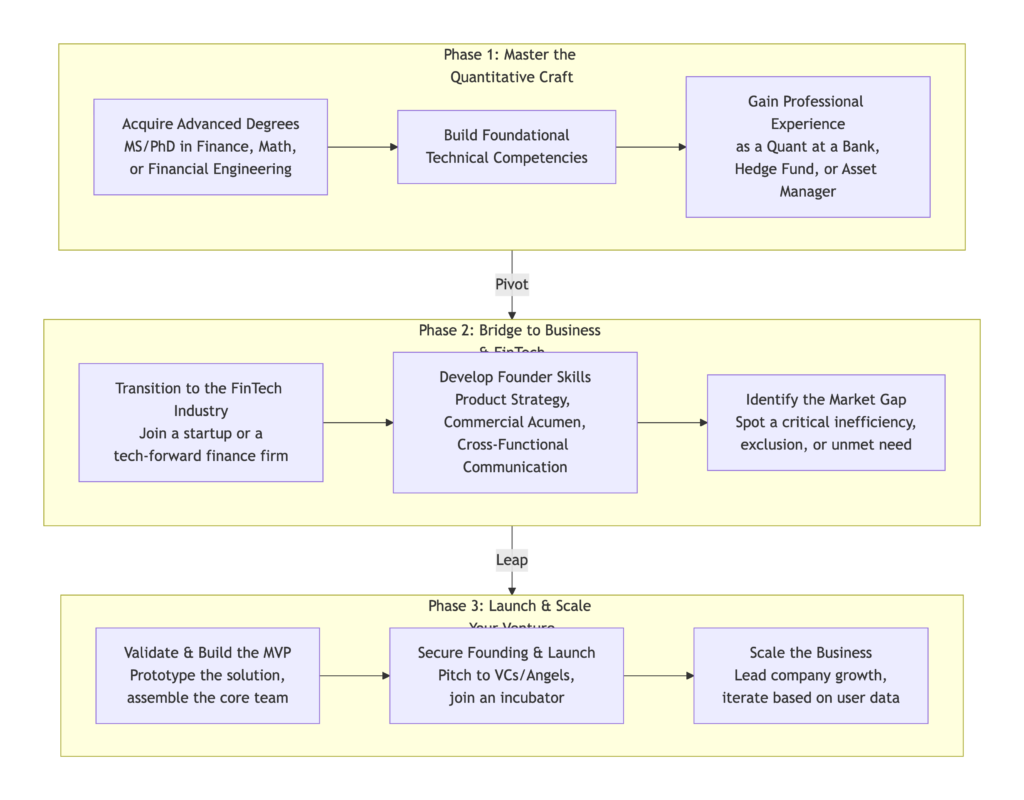
The Career Progression: A Visual Roadmap
The journey is a strategic progression through three major phases: mastering the core technical craft, gaining crucial industry and entrepreneurial insight, and finally, executing the vision.
Phase 1: Building an Unshakable Quantitative Foundation
This initial phase is about achieving elite competency. A career as a quantitative analyst (“quant”) is the essential training ground, demanding a rare mix of skills in mathematics, programming, and financial theory.
Education & Credentials: A bachelor’s degree in a rigorous field like mathematics, statistics, computer science, or physics is the starting point. Most successful quants then pursue a master’s or PhD in financial engineering, computational finance, or financial mathematics. Professional certifications like the Chartered Financial Analyst (CFA) or the Certificate in Quantitative Finance (CQF) add specialized credibility.
Core Skill Mastery: You must achieve fluency in:
Programming: Python and C++ are essential for statistical analysis, modeling, and building high-frequency trading applications.
Mathematical Modeling: Deep knowledge of calculus (including stochastic), linear algebra, probability, and Monte Carlo simulation techniques is non-negotiable.
Financial Theory: Expertise in portfolio theory, derivative pricing, and risk management forms the basis of all applied work.
Professional Experience: Landing a role at an investment bank, hedge fund, or asset manager is the crucible. Here, you move from theory to practice—developing trading algorithms, pricing complex derivatives, and building risk models. The goal is to transition from executing tasks to owning projects and understanding how your models impact business decisions.
Phase 2: Bridging to Business and the FinTech Mindset
This is the pivotal transition from a specialist to a generalist with a founder’s perspective. Moving into the fintech sector itself is the most direct path.
Make the Industry Jump: Seek a role at a fintech startup or a tech-driven financial firm. This exposes you to a completely different culture. Fintech rewards collaboration, agility, and a generalist mindset over the rigid expertise often prized in traditional finance.
Develop “Founder” Skills: This stage is less about deep technical research and more about:
Product Strategy: Learning how customer feedback directly shapes development priorities in rapid iteration cycles.
Commercial Awareness: Understanding unit economics, customer acquisition costs, and what drives the business model.
Cross-Functional Communication: Translating complex quantitative insights for engineers, marketers, and investors.
Identify the Problem Worth Solving: This is the core of the entrepreneurial leap. The best fintech founders spot glaring inefficiencies, gaps, or exclusion in the market. For example, some founders identified that sophisticated quantitative strategies were locked behind institutional walls, systematically excluding ordinary investors—a problem they solved by founding their own companies.
Phase 3: Launching and Scaling Your Venture
This is the execution phase, where preparation meets opportunity.
Validate and Build the MVP (Minimum Viable Product): Treat every academic and professional project as a potential prototype. Many successful founders turned their master’s capstone projects into their firm’s first production engines. Begin building a simple, focused version of your solution.
Assemble the Founding Team: You rarely build a company alone. A technical founder needs co-founders with complementary skills in areas like business development, software engineering, and product design. Your professional network is critical here.
Secure Funding and Incubation: Fintech startups often pursue venture capital, angel investment, or government grants. Having a demonstrable prototype and a clear mission is key. Success stories often involve early validation through incubators or accelerators hosted by major financial institutions or exchanges.
Lead and Scale: As a founder, your role shifts from quantitative expert to company leader. You’ll set the vision, raise capital, hire and manage a cross-functional team, and constantly adapt your product based on user data and market feedback.
The Founder’s Mindset: Your Key Differentiator
Beyond the plan, success hinges on a fundamental mindset shift:
From Perfect to Pragmatic: In academia and traditional finance, a perfectly calibrated model is the goal. In a startup, a “good enough” solution that gets to market and learns from users is often more valuable than a delayed, perfect one.
Embrace the “Soft Skills”: The hardest skills to master in this transition are often the soft ones. Adaptability, curiosity, empathy, and collaboration become your most valuable assets as you navigate uncertainty and lead a team.
Passion for the Problem: A deep, genuine desire to solve a specific financial problem is what sustains founders through the immense challenges of building a company. It’s the fuel for the long journey from quant to founder.
The road from quantitative analyst to fintech founder is demanding, requiring continuous learning and adaptation at every stage. However, for those with the technical depth, the commercial curiosity, and the resilience to lead, it represents one of the most direct ways to turn analytical prowess into tangible, widespread impact in the world of finance.