Becoming a medical malpractice lawyer typically takes 7-9 years of education and training before handling a case independently, but it leads to a specialized practice where top attorneys can earn well into the mid-six-figures. This path is one of the most demanding yet financially and intellectually rewarding in law, combining complex medicine with high-stakes litigation to help patients seek justice.
What is Medical Malpractice Law?
Medical malpractice law falls under civil litigation, where plaintiffs (injured patients) must prove that a healthcare provider’s negligence caused them harm. This isn’t about a simple bad outcome; it requires establishing a breach of the “standard of care”—what a reasonably competent professional would have done under similar circumstances.
Common case types include:
Surgical Errors: Wrong-site surgery, anesthesia mistakes, or leaving instruments inside a patient.
Misdiagnosis or Delayed Diagnosis: Especially critical in time-sensitive conditions like cancer or heart attacks.
Birth Injuries: Resulting in conditions like cerebral palsy or Erb’s palsy for the newborn.
Medication Errors: Incorrect dosage or harmful drug interactions.
Failure to Obtain Informed Consent: Performing a procedure without the patient’s full understanding of the risks.
The Medical Malpractice Career Timeline
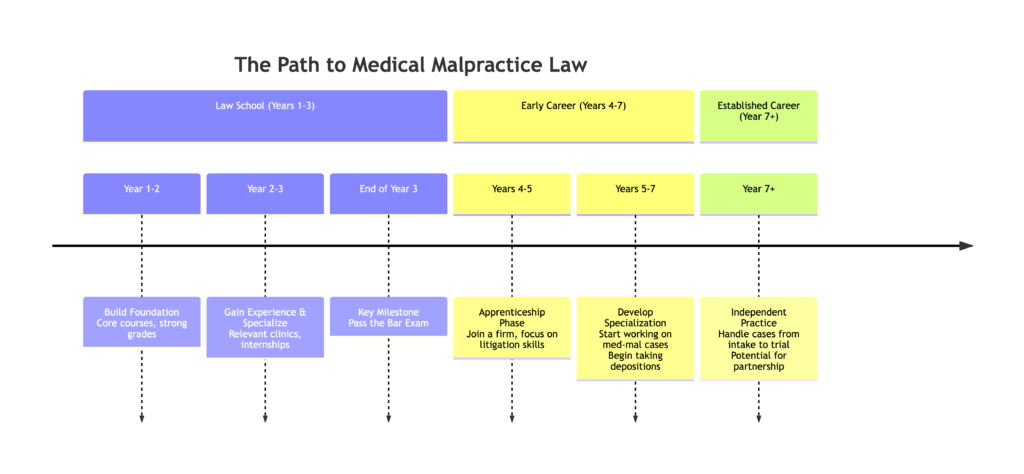
The journey from first-year law student to practicing medical malpractice attorney is a long-term investment. Here is a visual overview of the key phases:
Phase 1: Law School (Years 1-3)
The foundation is built here. The first year focuses on core courses like Torts (essential for negligence), Civil Procedure, and Contracts. Achieving high grades is critical for securing future opportunities.
During Years 2 and 3, you must strategically specialize:
Coursework: Take Medical Malpractice, Advanced Torts, Health Law, and Evidence.
Practical Experience: Secure internships or externships at firms that handle personal injury or medical malpractice. Participate in mock trial or moot court to hone litigation skills.
Clinical Work: Some schools offer legal clinics focused on health or medical advocacy, providing direct client experience.
The capstone is passing your state’s Bar Exam, a rigorous two-day test on legal knowledge and ethics.
Phase 2: Early Career & Apprenticeship (Years 4-7)
New attorneys rarely start in medical malpractice. Most begin in broader personal injury or insurance defense firms to master litigation fundamentals.
Years 4-5: You’ll learn the mechanics of litigation—drafting pleadings, managing discovery, and writing motions. The focus is on developing a keen eye for detail and a strong work ethic.
Years 5-7: This is the crucial transition into specialization. Under supervision, you’ll start reviewing medical records, consulting with expert witnesses, and assisting in depositions of doctors. Mastery of medical research and the ability to translate complex jargon for a jury are key skills developed here.
Phase 3: Established Medical Malpractice Attorney (Year 7+)
By this stage, you are likely handling your own caseload, managing cases from intake to settlement or trial. Responsibilities include:
Case Screening: Evaluating 10-20 potential cases to find the 1 with clear merit and provable negligence.
Expert Witness Collaboration: Working closely with medical experts to establish the standard of care and its breach.
Trial Advocacy: Presenting complex medical facts compellingly to a judge and jury.
Career paths may lead to partnership in a firm, a role as in-house counsel for a hospital (defense-side), or establishing your own boutique practice.
Essential Skills for Success
Beyond legal knowledge, top medical malpractice lawyers possess:
Analytical Acumen: Digesting dense medical records and scientific literature.
Attention to Detail: A single overlooked note can make or break a case.
Communication Skill: Simplifying complex medical concepts for jurors and clients.
Tenacity and Resilience: These cases are long (often 2-4 years), expensive, and fiercely defended.
Career Outlook and Earning Potential
This is a high-stakes, high-reward field. Law firms heavily invest in each case (expert witnesses, medical illustrations, trial costs), but successful verdicts or settlements can be substantial. While salaries vary widely by geography and firm size:
Mid-Level Attorney (5-9 years experience): Can earn between $120,000 – $250,000.
Senior Attorney/Partner (10+ years): Often commands $300,000 – $1,000,000+, particularly if they have a strong record of trial wins.
The demand for skilled attorneys remains stable, as medical errors, unfortunately, continue to be a leading cause of death and injury.
Your First Steps on the Path
If this career appeals to you, start now:
Excel in Undergrad: Focus on GPA and develop critical thinking skills. Science courses can be advantageous.
Ace the LSAT: A high score opens doors to top-tier law schools.
Research Law Schools: Look for those with strong trial advocacy programs, health law concentrations, and related clinical opportunities.
Network: Connect with current medical malpractice lawyers for informational interviews to understand the day-to-day reality.
Becoming a medical malpractice lawyer is a marathon, not a sprint. It requires intellectual curiosity, unwavering dedication to clients, and the fortitude to face powerful institutions. For those who persist, it offers a career of profound impact and professional prestige.