For many accountants, the leap from recording financial history to shaping financial future is the ultimate career evolution. Moving from a core accounting role to a leadership position in Financial Planning & Analysis (FP&A) represents a shift from compliance and precision to strategy, influence, and business partnership. This transition is not just a change in title but a fundamental change in mindset, skillset, and impact.
This guide provides the roadmap for making that successful pivot, turning your foundational accounting expertise into the strategic acumen required to lead an FP&A team.
The Mindset Shift: Accountant vs. FP&A Director
The first step is understanding the core differences in focus and output. Your accounting training is an invaluable asset, but the application changes dramatically.
| Aspect | Core Accounting Role | FP&A Director Role |
|---|---|---|
| Primary Focus | Historical Accuracy & Compliance: Recording what has happened. Ensuring financial statements are correct and adhere to GAAP/IFRS. | Future Performance & Strategy: Forecasting what will happen. Informing decisions to shape future financial outcomes. |
| Key Output | Financial Statements (Income Statement, Balance Sheet, Cash Flow), Audit Reports, Tax Filings. | Budgets, Forecasts, Financial Models, Management Reports, Strategic Recommendations. |
| Core Activities | Bookkeeping, closing the month-end, reconciliations, audit support, tax preparation. | Business partnering, variance analysis, scenario modeling, capital allocation analysis, board presentations. |
| Time Orientation | Backward-looking (Last month, last quarter, last year). | Forward-looking (Next quarter, next year, 3-5 year plan). |
| Key Mindset | Precision & Rule-Following: “Is this number correct and compliant?” | Insight & Influence: “What does this number mean, and what should we do next?” |
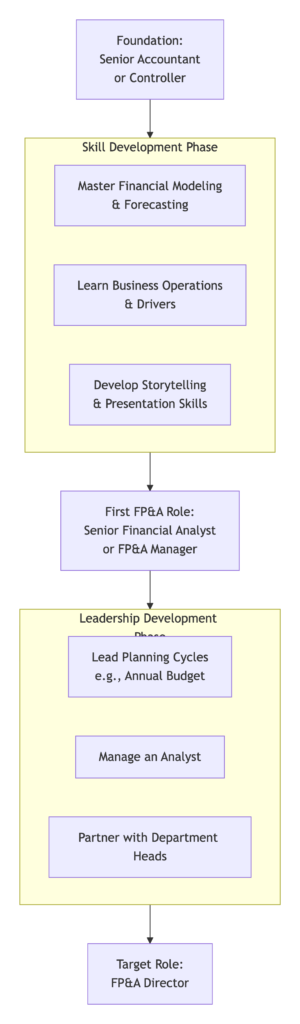
The Career Progression: A Visual Roadmap
Transitioning is rarely a single jump. It’s a strategic progression where you build upon your accounting foundation. Here is a typical pathway:
Building the Essential FP&A Skillset
Your accounting expertise in debits, credits, and GAAP is a powerful foundation. To transition, you must layer on these critical FP&A competencies:
- Financial Modeling & Forecasting: Move from recording transactions to building dynamic models that project revenue, expenses, and cash flow. Mastery of Excel is a given; familiarity with planning software like Adaptive Insights, Anaplan, or Hyperion is a major plus.
- Business Partnering & Communication: An FP&A Director is a translator between finance and the rest of the business (Sales, Marketing, Operations). You must learn to ask the right questions, understand operational drivers, and present financial data as a compelling business narrative to non-financial leaders.
- Strategic Analysis: Go beyond variance reporting (“we were 10% over budget”) to root-cause analysis and strategic recommendation (“we were 10% over budget because campaign X underperformed; we recommend reallocating funds to channel Y, which is expected to improve ROI by 15%”).
- Leadership & Influence: You will guide the budgeting process, manage a team of analysts, and influence executives. Developing soft skills in change management, negotiation, and team leadership is crucial.
Your Practical Transition Plan
Step 1: Leverage Your Current Role (The “Inside Move”)
Start acting like an FP&A professional before you have the title.
- Volunteer for Cross-Functional Projects: Offer to help the sales or marketing team analyze the profitability of a new initiative.
- Enhance Your Reporting: When you deliver monthly results, add a slide with a forward-looking “key takeaways and recommendations” section.
- Shadow the FP&A Team: Express interest to your manager and the FP&A director. Ask if you can help with a piece of the quarterly forecast.
Step 2: Acquire Formal Credentials (The “Proof of Pivot”)
While not always mandatory, certifications bridge the credibility gap.
- CPA (Certified Public Accountant): You likely have this. It remains a gold standard for financial credibility and is highly valued.
- FP&A-Specific Certification: The Certified Corporate Financial Planning & Analysis Professional (FPAC) credential is designed specifically for this field and signals deep commitment.
- MBA or Relevant Master’s: An MBA can accelerate the transition, especially for director-level roles, by formalizing strategy and leadership training.
Step 3: Target the Right First FP&A Role
You may not land a Director role immediately. A strategic stepping stone is key.
- Target Title: Senior Financial Analyst or FP&A Manager.
- Target Industry/Company: Look for companies that value deep accounting knowledge in their FP&A hires (e.g., manufacturing, where cost accounting is crucial, or a company undergoing an IPO/SOX implementation).
- Leverage Your Niche: In interviews, position yourself as the candidate who ensures forecasts and models are not just insightful but also auditable, accurate, and GAAP-compliant.
The Compensation Upside
The transition brings significant financial reward, reflecting the shift from a cost-center to a value-center role. While salaries vary by location and company size:
- Senior Accountant/Controller: Often ranges from $85,000 – $130,000.
- FP&A Director: Typically commands a range of $140,000 – $220,000+, with total compensation (including bonuses) frequently exceeding $250,000 at larger firms. This represents a substantial increase in earning potential.
Conclusion: Your Accounting Foundation is Your Superpower
The path from accountant to FP&A Director is a journey from being the historian of the business to becoming its strategist. Your meticulous understanding of the general ledger, revenue recognition, and cost accruals is not a limitation—it is your unique superpower. It allows you to build forecasts that are not just imaginative but grounded in financial reality.
By proactively developing your analytical, partnering, and leadership skills, you can reframe your career narrative. Stop being seen as the person who closes the books, and start positioning yourself as the person who can help write the next chapter of the company’s growth.